

Core Principles of a Productive Trolling Spread
A trolling spread is not a passive method of covering water. It is a calculated hydrodynamic illusion designed to replicate a panicked bait school and trigger an aggressive predatory response from game fish. The proficiency of an angler is often defined by their ability to execute a disciplined trolling spread setup. This system must present a variety of targets that maximize attraction while preventing operational failures like line tangles. The primary objective is to create what can be described as 'controlled chaos' behind the boat.
This controlled chaos is the foundation of all effective offshore trolling techniques. It involves presenting different lure actions, colors, and sizes at specific distances and depths to appeal to the varied feeding behaviors of pelagic species. A well-organized spread functions as a cohesive unit, with each lure playing a specific role in the overall presentation. It is this strategic organization that separates anglers who consistently produce from those who simply hope for a strike.
Before detailing specific positions or lures, it is critical to understand the philosophy of attraction. The wake of a boat, with its associated noise and turbulence, is a powerful attractant. A productive spread leverages this disturbance, placing lures in zones where they are most likely to be seen and attacked. The ideal spread is also dynamic, not static. It requires constant adjustment based on sea state, water clarity, and the specific target species, a principle we will explore in the following sections.
Strategic Line Positioning for Maximum Coverage
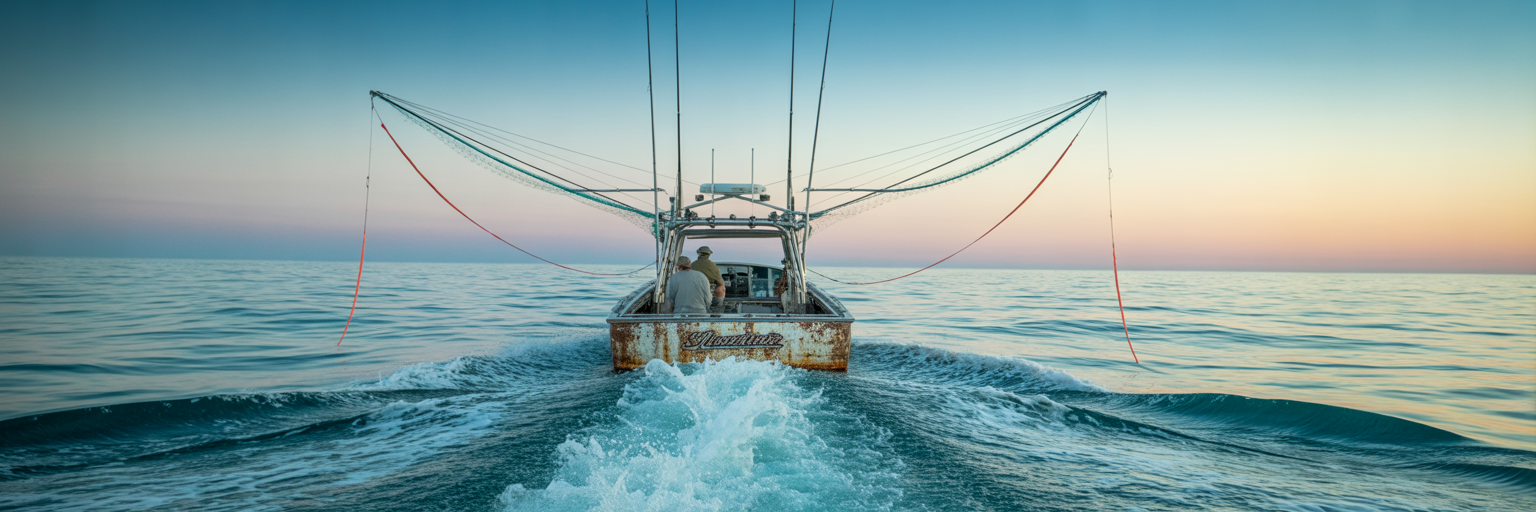
A foundational and highly effective configuration for offshore trolling is the standard five-line spread. This arrangement provides comprehensive coverage both in the turbulent propwash and in the clean water lanes outside the wake. Understanding the specific function of each position is essential for building a productive presentation. The architecture of this spread creates a layered field of opportunities for predators.
The two flat lines are positioned closest to the transom, running directly from the rod tips. The short flat sits just behind the boat in the most intense propwash, attracting aggressive strikes with its noise and vibration. The long flat runs behind it, extending the presentation within the turbulent zone. These positions are ideal for lures that create significant surface commotion.
To achieve width, outriggers are indispensable. Understanding how to set outriggers for trolling involves positioning lines to run lures in the cleaner water outside the wake, where more cautious fish often hunt. The short rigger line is set on the first clean water lane, while the long rigger is staggered farther back in the second lane. This expands the spread’s footprint and presents lures to fish that may be wary of the boat's direct path. Finally, the shotgun line is positioned in the center, far behind all other lines. This high-stakes placement targets the largest and most cautious trophy fish, such as marlin and bigeye tuna, that often trail the main commotion at a distance.
| Position | Location in Wake | Primary Function | Common Target Zone |
|---|---|---|---|
| Short Flat | Close to transom, in propwash | Attracts aggressive strikes with noise/vibration | Inshore edge of propwash |
| Long Flat | Behind short flat, still in propwash | Extends the turbulent zone presentation | Offshore edge of propwash |
| Short Rigger | Outrigger, in clean water outside wake | Provides width, targets cautious fish | First clean water lane |
| Long Rigger | Outrigger, staggered behind short rigger | Expands the spread's footprint | Second clean water lane |
| Shotgun | Center, far behind all other lines | Targets wary, high-value trophy fish | Deep, undisturbed water |
This table outlines the standard positions in a five-line trolling spread. The distances and specific lure choices can be adjusted based on sea conditions and target species.
Selecting Lures for a Dynamic Presentation
With the spread’s architecture established, lure selection becomes the next critical variable. A uniform spread is a significant tactical error. The most effective presentations offer a varied and irresistible menu for game fish, and contrast is essential for success. When selecting your big game fishing lures, consider these key factors:
- Size: Varying lure sizes mimics the natural diversity of a bait school.
- Shape: Different head shapes produce distinct actions, from aggressive chugging to subtle swimming.
- Color: Match color to water clarity and light conditions for maximum visibility.
- Action: Combine lures with different movements to create a dynamic and enticing presentation.
Matching lure action to position is a hallmark of a professional approach. Aggressive chuggers and slashers perform best on the flat lines, where their commotion adds to the propwash turbulence. Smoother-running, more stable lures are better suited for the outrigger positions in cleaner water. For the shotgun position, a straight-running bullet or a smaller lure that mimics a fleeing baitfish is often the most productive choice.
Color theory also plays a crucial role. In overcast conditions or stained water, bright, high-contrast colors are more visible. A lure such as our Flamingo Abalone Bullet Lure is designed to stand out in low light and trigger aggressive strikes. In clear water and bright sun, natural patterns that imitate local baitfish are superior. This is where premium materials make a definitive difference. Handcrafted lures with features like the abalone resin design found in our Blue Large Resin Abalone lure provide unmatched flash and durability. For serious anglers, investing in lures engineered for peak performance is not a luxury; it is a necessity to avoid equipment failure when a trophy fish is on the line.
Fine-Tuning Speed and Spread Maintenance

Once the spread is deployed, trolling speed and diligent maintenance become the primary drivers of success. The optimal speed ensures each lure is swimming correctly, creating the intended action without blowing out of the water. For most pelagic species like tuna and marlin, a range of 5 to 9 knots is standard. However, this is not a fixed rule. The exception is high-speed trolling, where the target dictates the pace. The ideal wahoo trolling speed, for example, often exceeds 12 knots, requiring specialized lures designed to handle high velocities.
A proficient captain constantly monitors lure action and makes micro-adjustments to maintain peak performance. Sea conditions are the most significant factor influencing speed. In rough seas, slowing down may be necessary to keep lures in the water, while in calm conditions, a slight increase in speed can impart more action. The ability to adapt is enhanced by having access to a full range of high-performance options, which can be viewed across our complete collection.
Finally, a strict maintenance protocol is non-negotiable. A fouled lure is a useless lure, and debris is a primary cause of missed strikes. Institute a disciplined schedule for managing your spread:
- Check the spread every 15 to 20 minutes. Scan each lure to ensure it is running clean and free of weeds or other debris.
- Clear any fouled lines immediately. A lure dragging weeds will not attract fish and can create tangles with other lines.
- Confirm lure action after turns. Sharp turns can cause lines to cross or lures to tangle. Always verify the spread is swimming correctly after completing a maneuver.
Integrating Advanced Teasers and Dredges
To elevate a standard spread into a comprehensive fishing system, advanced tools like teasers and dredges are essential. These non-hooked attractors are designed to enhance the illusion of a large, active bait school, increasing the spread's drawing power. Squid chains and bird teasers create significant surface commotion, simulating feeding activity that can be seen by predators from a great distance. Their primary function is to raise fish into the spread, bringing them within striking distance of the hooked lures.
The dredge takes this principle a step further. Deployed underwater, a dredge is a collapsible rig that mimics a dense bait ball, one of the most irresistible sights for an apex predator. It is a premier tool for raising billfish and is fundamental to creating an effective marlin trolling spread. Teasers and dredges are typically positioned short off the transom corners, where they create maximum visual appeal without interfering with hooked fish.
As a guide from The Tackle Room emphasizes, a productive trolling spread functions as a coordinated formation, and these advanced tools amplify that effect. They work in concert with the main lure spread to create an overwhelming presentation that apex predators find difficult to ignore. Building a complete, high-performance system is the key to consistent success offshore. Anglers looking to construct their ultimate trolling setup can find the professionally rigged lures and accessories required at K2Fishing.