

Why You Must Use Teasers and Dredges for Success
In competitive big-game fishing, the use of teasers and dredges is a fundamental requirement for consistent success. These hookless attractors are engineered to simulate a school of baitfish, creating a large and compelling visual target for pelagic predators. Their primary function is to raise fish like marlin, tuna, and wahoo from the depths and draw them into the trolling spread. A spread without these tools presents a sparse, unconvincing offering to a predator accustomed to hunting dense baitballs.
Top tournament crews understand this principle. They do not simply troll lures; they create an illusion of a concentrated feeding opportunity that triggers an aggressive response. These tools are the foundation of high-performance big game trolling setups, transforming a simple spread into a dynamic, multi-layered presentation. The difference in effectiveness is not marginal, it is decisive.
Achieving this advantage requires more than passive deployment. It demands a coordinated system where every component works in concert to attract, excite, and convert opportunities into hookups. This is not an accessory strategy but a core discipline for any serious offshore angler.
Selecting the Right Teaser and Dredge Combination
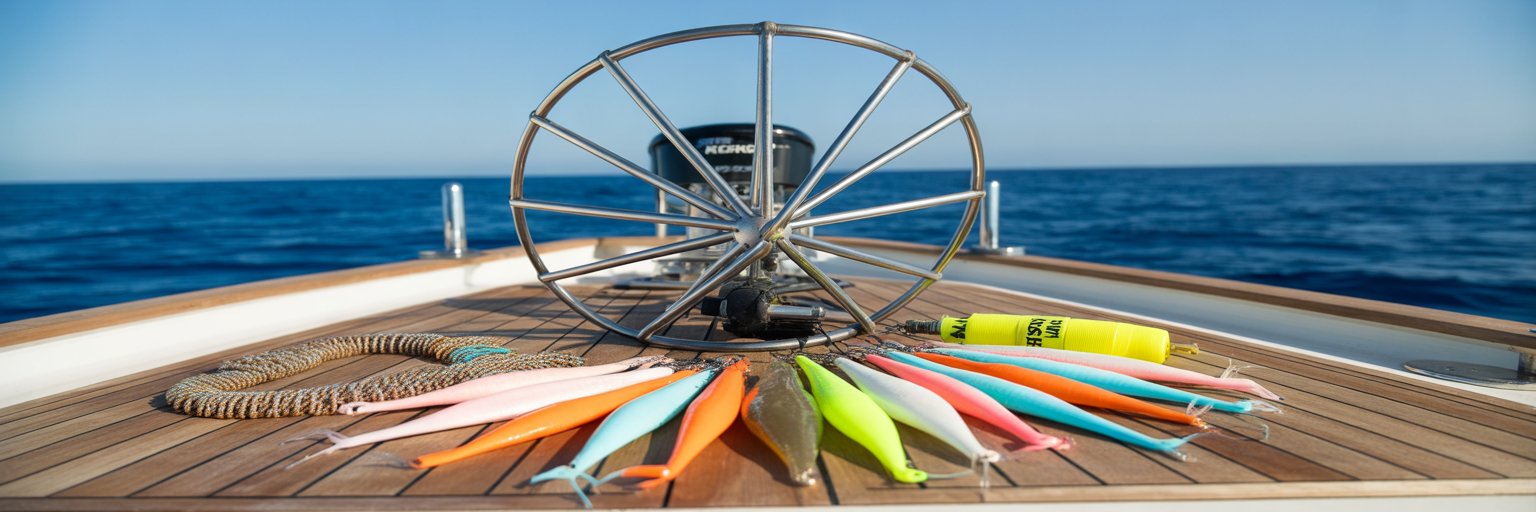
With the strategic importance of these tools established, selecting the correct combination of teasers and dredges is the next critical step. The choice depends on target species, trolling speed, and sea conditions. A poorly matched setup can be ineffective or even counterproductive, so careful consideration is essential for performance.
Dredge Types: Natural, Artificial, and Mixed
Dredges are broadly categorized by their composition. Natural bait dredges, typically made with mullet or ballyhoo, offer unparalleled realism and a potent scent trail that is highly effective at slower trolling speeds. Artificial dredges, constructed from durable rubber fish or squid, provide longevity and are superior for high-speed trolling when covering ground is the priority. As noted in publications like Marlin Magazine, many top tournament teams now favor mixed-bait dredges for their balance of durability and realism, combining the flash of artificials with the scent of a few natural baits.
Teaser Varieties: Surface and Sub-Surface
Teasers complement the dredge by adding another layer of attraction. Surface-splashing options like bird and squid chains create commotion and visual excitement that draws attention from a distance. Sub-surface teasers run deeper, adding to the bait school illusion initiated by the dredge. The right combination of offshore fishing teasers creates a comprehensive presentation that appeals to predators hunting at various depths.
Matching Your Gear to Target Species and Conditions
The final selection must be tailored to your objective. Large, flashy dredges are proven to be effective for raising billfish, while the chaotic surface action of a squid chain can be the ideal trigger for tuna. Matching your setup to the behavior of your target, whether it is tuna or marlin, is critical for success. You can find more information on what works for various species to refine your approach. The key is to build a system that presents the most convincing feeding opportunity for the specific predator you are targeting.
| Dredge Type | Primary Advantage | Best For | Considerations |
|---|---|---|---|
| Natural Bait (Mullet/Ballyhoo) | Unmatched realism and scent | Slower trolling speeds; targeting finicky billfish | High preparation time; less durable |
| Artificial (Rubber Fish/Squid) | Durability and ease of use | High-speed trolling; covering ground quickly | Lacks natural scent trail |
| Mixed-Bait (Natural & Artificial) | Balanced performance | Versatile for various conditions and species | Offers the best of both but still requires some bait prep |
Proper Rigging and Deployment Techniques
With the right gear selected, proper rigging and deployment become paramount to performance. A poorly deployed dredge will tumble, tangle, and fail to create the intended illusion. This guide on how to use a fishing dredge ensures correct deployment for maximum effectiveness. The process must be precise and methodical.
The optimal position for a dredge is 20 to 30 feet behind the boat, running just outside the turbulent prop wash where it remains highly visible. To achieve this depth and prevent tumbling at trolling speed, a heavy trolling weight between 8 and 16 pounds or a specialized deep-diving plug is required. This stability is non-negotiable.
Follow these steps for successful deployment:
- Attach the dredge to a heavy-duty retrieval line. This can be spooled on a high-capacity conventional reel or a dedicated electric reel.
- Connect the trolling weight or diving plug to the tow point ahead of the dredge bar. This ensures the dredge tracks straight and deep.
- Deploy the dredge slowly as the boat moves forward, allowing it to sink to its target depth without fouling.
- Secure the retrieval line. The dredge can be pulled from a downrigger, a dedicated boom, or a reinforced transom cleat paired with a robust reel.
Surface teasers, such as squid chains, should be run from the outriggers. This positions them in clean water lanes on either side of the prop wash, creating surface commotion that complements the deeper dredge without interfering with other lines. This systematic placement is the foundation of an organized and effective spread.
Executing the Bait-and-Switch Maneuver
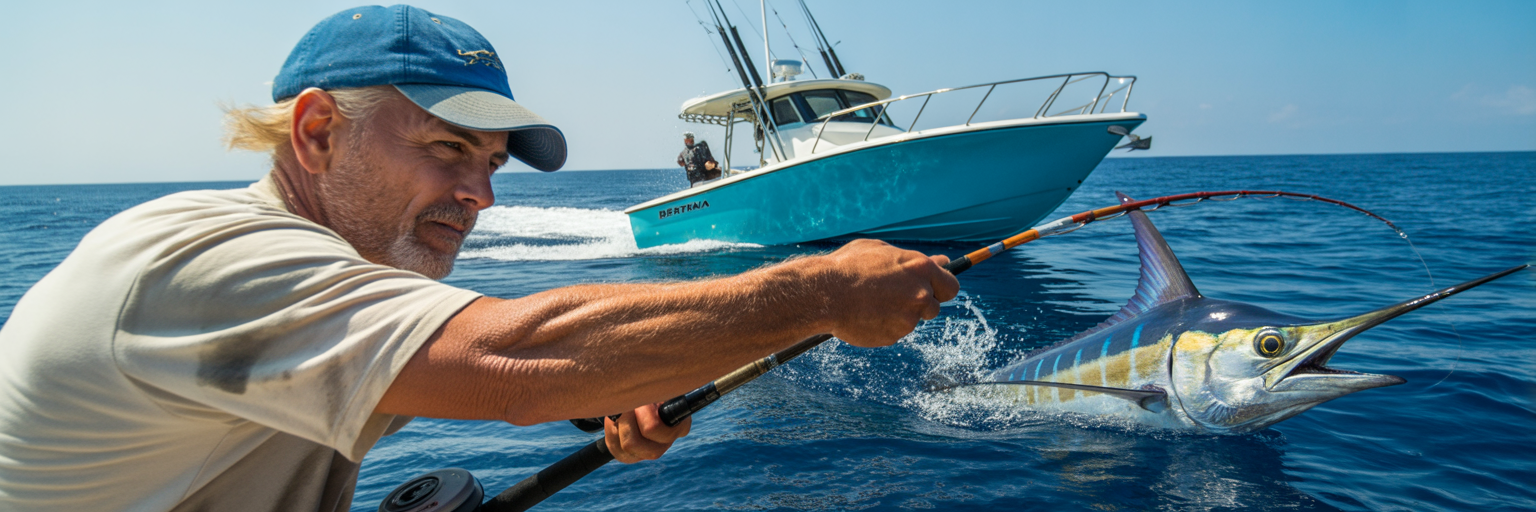
The ultimate purpose of a teaser and dredge system is to convert attraction into a hookup. The culmination of this effort is the bait and switch fishing technique, a coordinated maneuver that turns a curious fish into a committed strike. The dredge’s job is to bring the predator into the spread; the crew’s job is to complete the sale.
This requires a designated angler to be ready with a "pitch bait," typically a rigged ballyhoo or mackerel on a separate rod. When a predator rises to inspect the dredge, the action begins. The crew must work in unison to pull the dredge away from the fish, creating the illusion that the bait school is escaping. This action almost always triggers an aggressive response from the predator, which then seeks an easier target.
At that exact moment, the angler presents the pitch bait to the frustrated fish. This maneuver is one of the most effective marlin fishing techniques known, capitalizing on the predator's heightened aggression. While a natural bait is common, pitching a high-quality lure like one from our collection of large resin lures can trigger an equally aggressive strike. Success depends entirely on timing, teamwork, and readiness.
Advanced Equipment for Modern Dredge Fishing
Deploying heavy dredge systems presents significant physical challenges. The drag created by a multi-tiered dredge can exceed 100 pounds, placing immense strain on both equipment and crew. To manage these forces, modern hardware innovations have become essential for any serious dredge fishing operation. These tools are not luxuries but necessities for performance and safety.
Lightweight carbon-fiber booms and tapered fiberglass bars are engineered to maintain their shape under extreme load, ensuring the dredge presents a natural baitball profile. These advanced materials prevent the bar from collapsing, which would ruin the illusion. The most critical advancement, however, has been in retrieval systems. Specialized 12V or 24V electric reels are now the standard for managing heavy dredges, allowing for rapid retrieval with the push of a button. This speed is vital when clearing the gear to fight a fish or execute a bait-and-switch.
As documented by Salt Water Sportsman, the adoption of dedicated electric reels and boom systems has been a primary driver in allowing center consoles to effectively deploy tournament-grade dredge setups once limited to large sport-fishers. Whether manual or electric, a robust retrieval system is the backbone of any modern dredge program, providing the power and control needed to handle the heaviest loads.
Integrating Teasers into a Complete Trolling Spread
A successful trolling strategy synthesizes all elements into a single, cohesive presentation. The dredge and teasers are not standalone items but the core of an integrated system designed to simulate a competitive feeding environment. A well-orchestrated spread is the hallmark of a professional operation and dramatically increases hookup ratios.
The blueprint for an effective spread is logical and layered:
- Position the dredge as the centerpiece. It runs deepest and closest to the boat, forming the foundation of the bait school illusion.
- Run surface teasers from the outriggers. Bird or squid chains should splash in the clean water lanes to the sides of the dredge, creating a multi-layered visual that suggests a larger body of bait.
- Place hooked lures in strategic positions. These should run behind and to the sides of the teasers, appearing as stragglers from the main school and presenting an easy target.
- Stagger all lines meticulously. Ensure different lengths and positions to prevent tangles, especially during turns.
The final element is your hooked lures. A lure with exceptional flash and action is often the target a predator commits to after being drawn in by the teasers. For example, a high-performance lure like the K2Fishing Blue Large Resin Abalone lure running in a clean lane becomes an irresistible target. To build your perfect spread, explore our complete collection of handcrafted offshore trolling lures.
Fishing Teasers FAQ
What are fishing teasers?
Fishing teasers are hookless attractors, such as squid chains, bird chains, daisy chains, dredges, and hookless lures, trolled to imitate a school of bait. Their job is to pull fish up into the spread, where they find a hooked lure or a pitch bait.
Where do fishing teasers go in a trolling spread?
Run surface teasers from the outriggers or transom corners in clean water lanes, and run dredges roughly 20 to 30 feet back, just outside the prop wash. Hooked lures should sit behind and beside the teasers so a fish that rises to the commotion finds a lure it can eat.
Do fishing teasers work for tuna and wahoo, or just marlin?
They work for all of them. Squid chains and bird chains are deadly for tuna, and flashy teasers help raise wahoo and mahi. Marlin crews rely on teasers most because they set up the bait-and-switch. For specific picks, see our list of the best trolling teasers for marlin.
What is the difference between a dredge and a teaser?
A dredge is a type of teaser that runs below the surface and presents a three-dimensional bait school, while most other teasers run on the surface to create splash and commotion. Read more in dredge vs teaser fishing.









