

For decades, anglers have debated lure color based on observation and intuition. A scientific understanding of a marlin’s vision, however, reveals that success is not about a specific hue, but how that hue performs against a sunlit surface. The key to attracting marlin and triggering a definitive strike lies in mastering the interplay of contrast, silhouette, and dynamic flash. This approach moves beyond anecdotal evidence to a repeatable, performance-based strategy.
Understanding Marlin Vision for Attracting Marlin
To select the most effective lures, one must first understand the sensory capabilities of the target. A marlin’s eye is a highly adapted predatory tool, but it perceives the world differently than a human’s. According to research highlighted by The Fishing Website, marlin possess cone cells that are most sensitive to the violet-blue and blue-green parts of the spectrum. This color perception is sharpest when a marlin views a lure from below, where it is silhouetted against the bright, downwelling light of the ocean surface.
This biological reality directly challenges certain industry trends. For instance, the marketing of UV-reactive lures often overlooks a critical detail: marlin eyes contain natural filters that block ultraviolet light. These filters protect their vision in the intense light of the upper water column, but they also render UV enhancers ineffective for directly stimulating a response. The fish simply cannot perceive the UV wavelengths that these products are designed to reflect.
Therefore, a successful lure presentation is not about appealing to a marlin’s sense of color in the way a human might appreciate it. Instead, it is about creating a visual trigger that their predatory instincts cannot ignore. The primary drivers of a strike are contrast against the background, a recognizable silhouette that mimics prey, and the dynamic movement that signals vulnerability. Color is merely a tool to achieve the necessary contrast, but the lure’s profile and action are what ultimately convert curiosity into commitment.
The Critical Role of Contrast and Silhouette

With a clear understanding of how marlin perceive their environment, lure selection becomes a tactical exercise in maximizing visibility. The static properties of a lure, its shape and color pattern, are the foundation of this strategy. They must work together to create a compelling profile that stands out from the visual noise of the open ocean.
Leveraging Dark Colors for Maximum Visibility
When viewed from below, a lure is seen against the bright canvas of the sky. In these conditions, dark, solid colors create the most defined and easily detectable silhouette. Lures in solid black, purple, or dark blue absorb light, producing a sharp outline that is highly visible to a predator hunting from the depths. This effect is particularly pronounced during low-light periods such as dawn and dusk, when the ambient light is softer and a stark profile offers a significant advantage.
Using High-Contrast Patterns to Mimic Forage
Beyond solid colors, high-contrast patterns are exceptionally effective because they imitate the natural appearance of common prey. Classic combinations like blue-and-white or black-and-red mimic the dorsal and ventral sides of baitfish such as flying fish, mackerel, or squid. This familiar profile presents a recognizable food source, triggering a feeding response based on established predatory patterns. These high-contrast principles are embodied in many purpose-built large resin lures designed for bluewater visibility.
Adapting Lure Profiles to Environmental Conditions
The final element of silhouette management is adapting your selection to the immediate environment. The best colors for marlin are those that provide the greatest contrast in the prevailing water and light conditions. A lure that excels in the clear blue water of the Bahamas may become nearly invisible in the greener waters off the Pacific coast. The objective is always to choose a profile that remains distinct and trackable for a hunting marlin.
| Water/Light Condition | Recommended Lure Profile | Strategic Rationale |
|---|---|---|
| Bright Sun, Clear Blue Water | Natural patterns (blue/silver, green/yellow) | Mimics local baitfish and blends naturally while still offering flash and movement. |
| Overcast, Dawn, or Dusk | Dark, solid colors (black, purple, dark blue) | Creates the sharpest, most defined silhouette against the muted sky for maximum visibility. |
| Murky or Green Water | High-contrast patterns (black/red, pink/white) or bright chartreuse | Cuts through low-visibility water and provides a strong visual target that is easy to track. |
This table provides a framework for adapting lure selection to environmental conditions. These recommendations are based on the principle of maximizing visual contrast to ensure the lure is detected by a marlin from a distance.
Maximizing Attraction with Dynamic Flash
While contrast and silhouette create the initial target, it is dynamic flash that often provides the final, irresistible trigger for a strike. The flickering light emitted by a well-designed lure imitates the scales of a panicked or injured baitfish, a potent signal that activates a marlin’s deep-seated predatory instincts. However, not all flash is created equal. The material and construction of the lure determine the quality and effectiveness of this critical visual cue.
The performance of different flash materials varies significantly:
- Painted Surfaces: These provide a base color and can contribute to the lure's overall silhouette, but they lack the dynamic light play needed to simulate a living creature. Their reflection is static and one-dimensional.
- Holographic Foils: An improvement over paint, foils offer strong reflection and can create an illusion of movement. Yet, upon closer inspection, they can appear flat and unnatural, potentially causing a wary marlin to turn away.
- Abalone Shell Inserts: This material delivers a complex, multi-dimensional shimmer that is unmatched by artificial alternatives. The natural iridescence of the shell reflects light from multiple angles, changing with the lure’s movement and the angle of the sun to create a truly lifelike appearance.
The superior performance of abalone shell lures comes from this inherent complexity. The natural, iridescent quality found in premium abalone shell lures, such as the Blue Large Resin Abalone lure, produces a shimmer that static paint or simple foils cannot replicate. This effect is amplified by the lure’s action. As the lure dives, wobbles, or surfaces, the abalone insert creates a pulsating signal that communicates "vulnerable prey" with exceptional realism. This synergy between action and flash is a cornerstone of advanced big game fishing tactics, compelling a marlin to strike with conviction.
Building a Cohesive High-Performance Trolling Spread
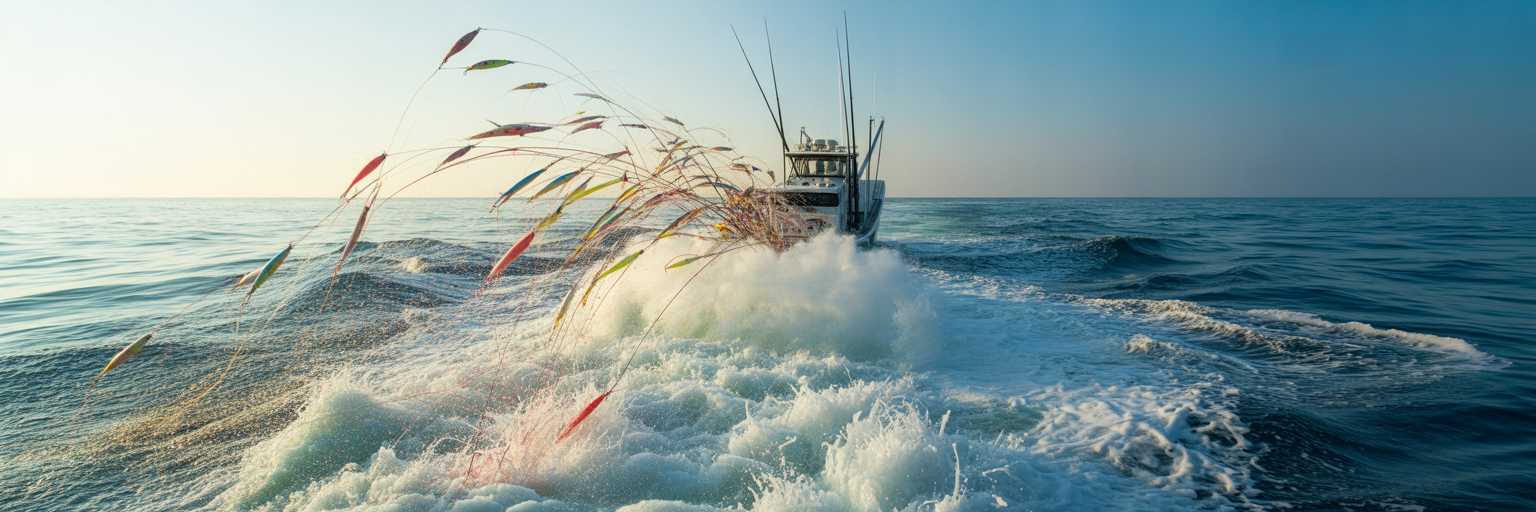
Choosing the right lure is only part of the equation. The ultimate goal is to orchestrate a complete presentation that simulates a bait ball and draws fish into the spread. This system-wide approach, which defines professional offshore trolling setups, synthesizes the principles of contrast, silhouette, and flash into a cohesive and irresistible offering. The spread should function as a single, dynamic unit designed to raise fish and convert their curiosity into strikes.
A high-performance spread is built with distinct components, each serving a specific role:
- Dredges and Chain Teasers: These are the primary attractants. Deployed below the surface, they create the illusion of a dense school of bait, producing significant commotion and flash. Their purpose is to capture a marlin's attention from a distance and draw it into the wake.
- Hook Lures: These are the "finishers." Positioned strategically within the spread, they are designed to be the most enticing and easily captured targets. Once a marlin is raised by the teasers, it will typically shift its focus to one of these individual lures for the attack.
For maximum effectiveness, position high-flash hook lures, particularly those with abalone inserts, in high-probability strike zones. The short corner and long rigger positions are ideal, as they present a clear target to a marlin tracking the larger teaser arrays. This placement ensures that the most compelling lure is in the right place at the right time.
Finally, always remember the foundational principle of "matching the hatch." While the science of flash and contrast is universal, the most successful presentations are tailored to the dominant local forage. The most successful anglers adapt these principles by researching what marlin are feeding on in a specific region, a process you can start by learning to fish by species. Success comes from combining proven science with on-the-water observation, a practice modern anglers often enhance by sharing findings online, much like businesses use digital marketing strategies to boost website traffic to improve collective outcomes.









